Device Statistics: Difference between revisions
Created page with "'''Device Statistics''' is a more detailed version of SMART attributes supported on most modern drives. Though support for them is less mainstream, they can give more detailed..." |
→Products: Rm erroneous header |
||
| Line 17: | Line 17: | ||
==Common statistics== | ==Common statistics== | ||
{| class="wikitable" summary="List of common Device Statistics stats." | {| class="wikitable" summary="List of common Device Statistics stats." | ||
|- | |- | ||
| Line 61: | Line 60: | ||
|Counts the number of times heads have loaded onto the platters from the ramp. Equivalent to 0xC1 Load/Unload Cycle Count. | |Counts the number of times heads have loaded onto the platters from the ramp. Equivalent to 0xC1 Load/Unload Cycle Count. | ||
|} | |} | ||
==Gallery== | ==Gallery== | ||
<gallery> | <gallery> | ||
File:TOSHIBA HDWR480 GSmartControl Device Statistics printout.png|Device Statistics printout from a TOSHIBA HDWR480. | File:TOSHIBA HDWR480 GSmartControl Device Statistics printout.png|Device Statistics printout from a TOSHIBA HDWR480. | ||
</gallery> | </gallery> | ||
Revision as of 07:53, 21 August 2022
Device Statistics is a more detailed version of SMART attributes supported on most modern drives. Though support for them is less mainstream, they can give more detailed and well-defined information.
Support by manufacturer
Support by manufacturer varies, with some being early adopters of the technology and others delaying adoption to many years later. Only manufacturers active in 2010 or later will be covered on this article.
Hitachi
Hitachi 3.5" drives have supported Device Statistics since the Jupiter and Jupiter-C families. In contrast, no 2.5" Hitachi family supports Device Statistics. They are the first adopter of Device Statistics.
Toshiba
Toshiba also were quite an early adopter of Device Statistics, as all 2.5" drives since the Toshiba MQ01ABD series have supported it, as well as all 3.5" drives since Toshiba MG03. Notably, this means that all models that use the new model number scheme support it, and those that use the older MK series numbering do not.
Seagate
Seagate F3 families have supported Device Statistics since Lamarr.
Western Digital
Support for Device Statistics on Western Digital Marvell families is limited, with a select few 3.5" families starting with Venice and Carmel supporting it.
Common statistics
| Stat name | Description |
|---|---|
| General statistics | |
| Lifetime Power-On Resets | Counts the number of device power cycles. Equivalent to 0x0C Power Cycle Count. |
| Power-on Hours | Counts the number of power-on hours. Equivalent to 0x09 Power-On Hours, but alternate units of measure are not used. |
| Logical Sectors Written | Counts the number of LBAs written by host. Equivalent to 0xF1 Total Host Writes. |
| Number of Write Commands | Counts the number of write commands from the host. |
| Logical Sectors Read | Counts the number of LBAs read by host. Equivalent to 0xF2 Total Host Reads. |
| Number of Read Commands | Counts the number of read commands from the host. |
| Date and Time TimeStamp | Can be set with a command, but normally equals number of milliseconds powered on, like how Power-on Hours indicates number of hours powered. Toshiba MG06 and later do not report precise milliseconds, but instead Power-on Hours converted to milliseconds (meaning that the number largely consists of zeros). |
| Free-fall statistics | |
| Overlimit Shock Events | Number of errors caused by shock. Equivalent to 0xBF G-Sense Error Rate. |
| Rotating media statistics | |
| Spindle Motor Power-on Hours | Counts the number of hours the spindle has spun for. |
| Head Flying Hours | Counts the number of hours heads are loaded onto the platters, rather than onto a ramp. Equivalent to 0xF0 Head Flying Hours on most drives, or 0xDE Loaded Hours on Toshiba drives. |
| Head Load Events | Counts the number of times heads have loaded onto the platters from the ramp. Equivalent to 0xC1 Load/Unload Cycle Count. |
Gallery
-
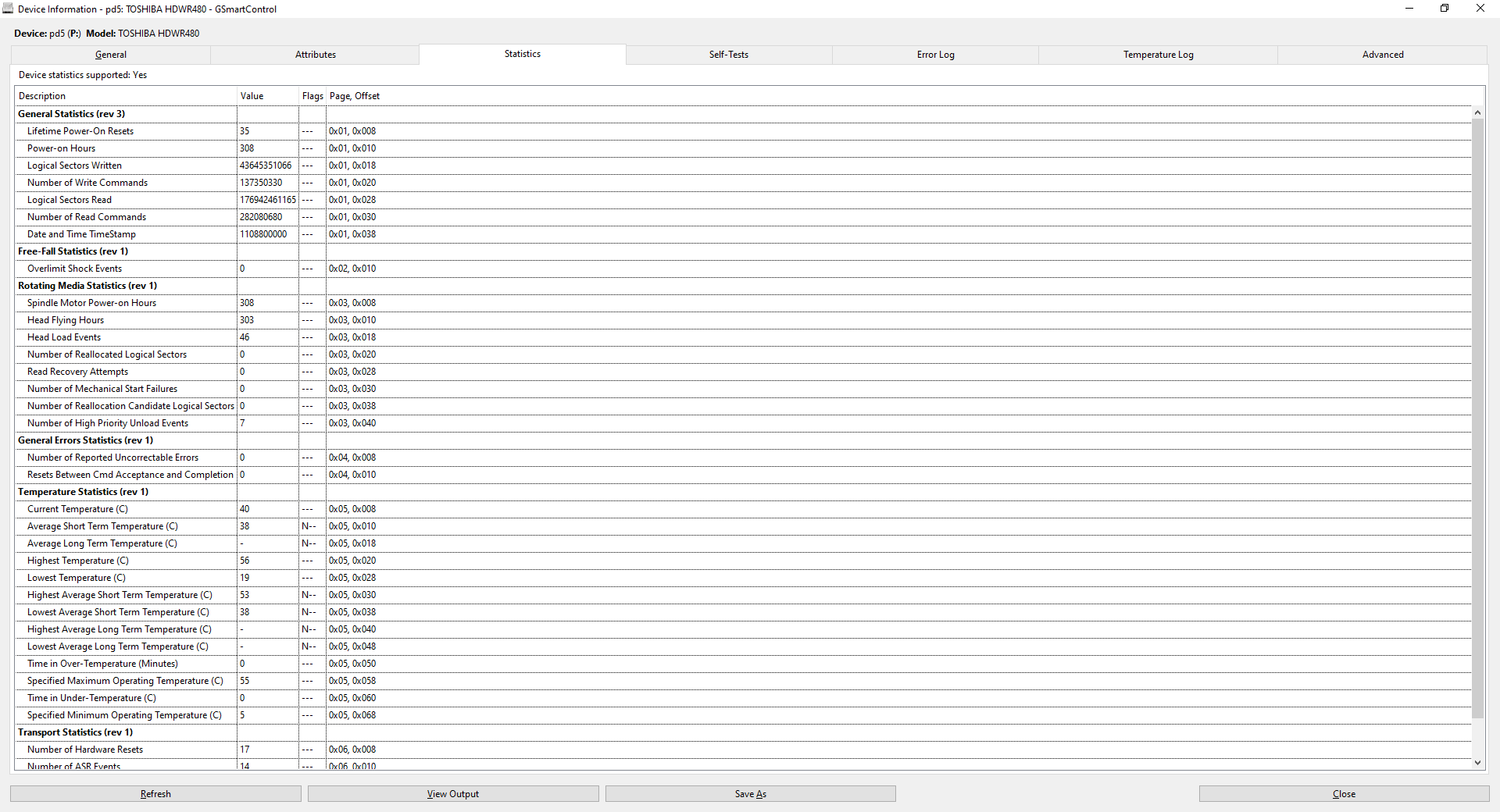 Device Statistics printout from a TOSHIBA HDWR480.
