TOSHIBA HDWD240: Difference between revisions
From Computing Classics Wiki
No edit summary |
No edit summary |
||
| Line 73: | Line 73: | ||
==Trivia== | ==Trivia== | ||
*This drive is the first two-platter retail branded Toshiba to be based off the Hitachi three-platter HDA, but with native Toshiba firmware and PCB, as proven by the Toshiba-style PCB part number of G0066A (where G is used as a prefix for Toshiba-made PCBs). Previously, Toshiba-branded drives using this HDA used modified Hitachi firmware and PCBs (with PCB part numbers prefixed with the HGST-style 0A or 0B, rather than G). | *This drive is the first two-platter retail branded Toshiba to be based off the Hitachi three-platter HDA, but with native Toshiba firmware and PCB, as proven by the Toshiba-style PCB part number of G0066A (where G is used as a prefix for Toshiba-made PCBs). Previously, Toshiba-branded drives using this HDA used modified Hitachi firmware and PCBs (with PCB part numbers prefixed with the HGST-style 0A or 0B, rather than G). | ||
==Gallery== | |||
<gallery> | |||
Toshiba HDWD240 G0066A PCB.jpg|Component side view of the G0066A PCB used on the HDWD240. The MCU is a Marvell 88i1017-NDB2 with date code 1929. | |||
</gallery> | |||
==References== | ==References== | ||
Revision as of 09:55, 24 December 2021
TOSHIBA HDWD240 is a hard drive model created by Toshiba. It is a 3.5" 4 TB SMR hard drive, based off the Hitachi HDA from the DT01 series with Toshiba style firmware. It is a rebadged TOSHIBA DT02ABA400, targeted at retail customers.
Similar models from other manufacturers include the WDC WD40EZAZ and ST4000DM004.
History
The HDWD240 was part of a 2019 expansion to the P300 family, including 5,400 RPM drives to it for the first time.[1] It replaces the models that were part of the long-discontinued Toshiba E300 family. This model serves as a low speed, low duty alternative to the TOSHIBA HDWE140.
SMART attributes
| ID | Name |
|---|---|
| 0x01/1 | Read Error Rate |
| 0x02/2 | Throughput Performance |
| 0x03/3 | Spin-Up Time |
| 0x04/4 | Start/Stop Count |
| 0x05/5 | Reallocated Sectors Count |
| 0x07/7 | Seek Error Rate |
| 0x08/8 | Seek Time Performance |
| 0x09/9 | Power-On Hours |
| 0x0A/10 | Spin Retry Count |
| 0x0C/12 | Power Cycle Count |
| 0xBF/191 | G-Sense Error Rate |
| 0xC0/192 | Power-off Retract Count |
| 0xC1/193 | Load/Unload Cycle Count |
| 0xC2/194 | Temperature (Max/Min/Current) |
| 0xC4/196 | Reallocation Event Count |
| 0xC5/197 | Current Pending Sector Count |
| 0xC6/198 | Uncorrectable Sector Count |
| 0xC7/199 | UltraDMA CRC Error Count |
| 0xDC/220 | Disk Shift |
| 0xDE/222 | Loaded Hours |
| 0xDF/223 | Load/Unload Retry Count |
| 0xE0/224 | Load Friction |
| 0xE2/226 | Load 'In'-time |
| 0xF0/240 | Transfer Error Rate? |
Trivia
- This drive is the first two-platter retail branded Toshiba to be based off the Hitachi three-platter HDA, but with native Toshiba firmware and PCB, as proven by the Toshiba-style PCB part number of G0066A (where G is used as a prefix for Toshiba-made PCBs). Previously, Toshiba-branded drives using this HDA used modified Hitachi firmware and PCBs (with PCB part numbers prefixed with the HGST-style 0A or 0B, rather than G).
Gallery
-
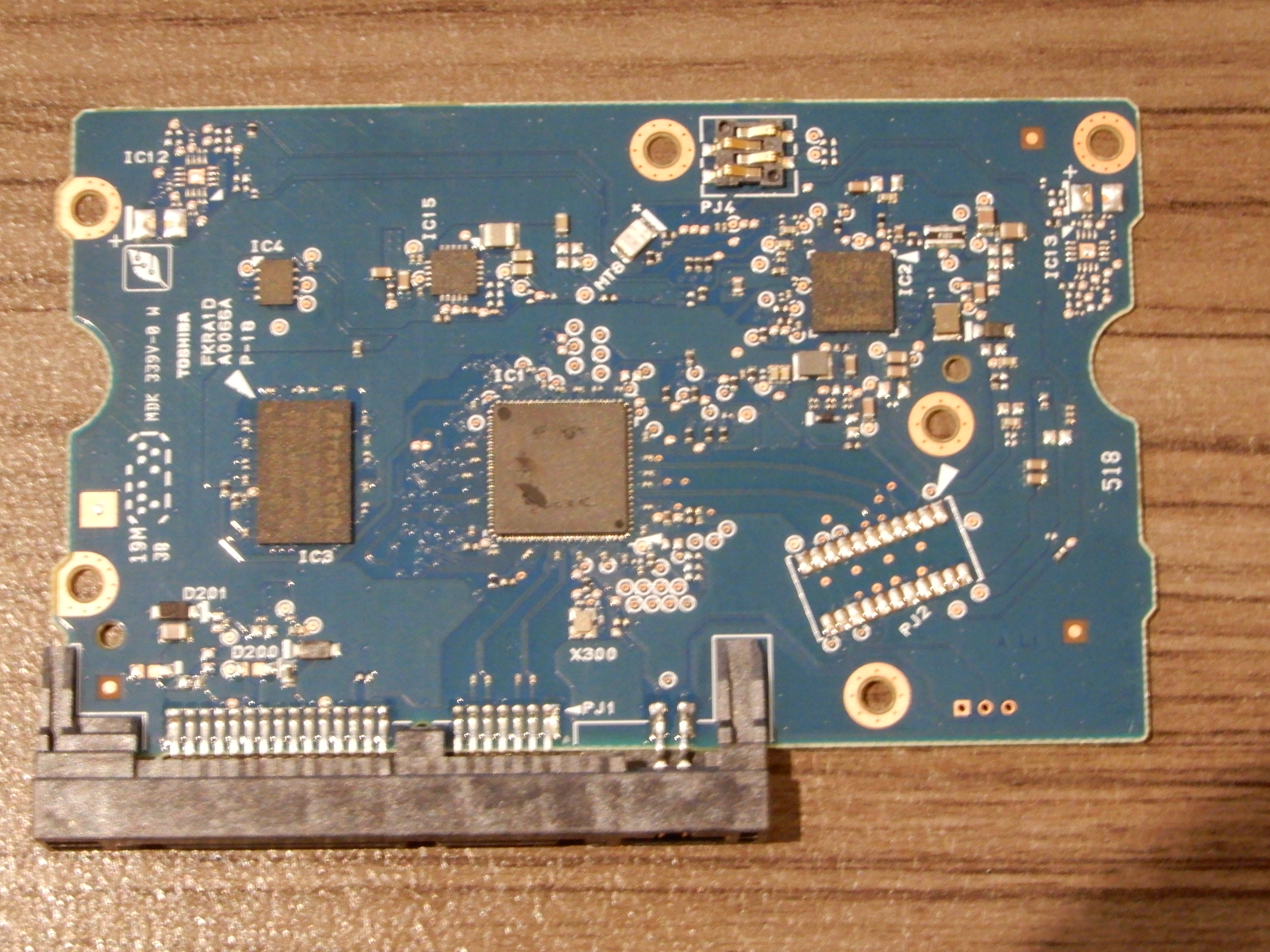 Component side view of the G0066A PCB used on the HDWD240. The MCU is a Marvell 88i1017-NDB2 with date code 1929.

References
- ↑ 1.0 1.1 Toshiba (3 December 2019). "Toshiba adds 4TB and 6TB capacity drives to P300 Desktop PC Hard Drive Series". Retrieved 25 March 2021.