TOSHIBA HDWR480: Difference between revisions
From Computing Classics Wiki
m Text replacement - "Top-down view of a" to "Top lid of a" |
Add GPL |
||
| Line 22: | Line 22: | ||
|command_set = ACS-3 Revision 5 | |command_set = ACS-3 Revision 5 | ||
|apm = Yes | |apm = Yes | ||
|aam = No | |||
|ncq = Yes | |ncq = Yes | ||
| | |gpl = Yes | ||
|scterc = Read: Disabled<br>Write: Disabled | |scterc = Read: Disabled<br>Write: Disabled | ||
|statistics = Yes | |statistics = Yes | ||
Revision as of 01:09, 12 September 2022
TOSHIBA HDWR480 is a hard drive model created by Toshiba. It succeeds the previous generation HDWR180, reducing the platter count to five while increasing the density from 1.33 to 1.6 TB/platter, and is a binned relabel of the TOSHIBA MG08ADA800E, an enterprise drive. Competitors include the WDC WD8001FZBX-xxASYAx, which uses the same platter count and density.
Units with full model numbers ending with an A (e.g. HDWR480UZSVA, like the example image) belong to the standard X300 family, whereas those ending with a B belong to the X300 Pro family.
SMART attributes
| ID | Name |
|---|---|
| 0x01/1 | Read Error Rate |
| 0x02/2 | Throughput Performance |
| 0x03/3 | Spin-Up Time |
| 0x04/4 | Start/Stop Count |
| 0x05/5 | Reallocated Sectors Count |
| 0x07/7 | Seek Error Rate |
| 0x08/8 | Seek Time Performance |
| 0x09/9 | Power-On Hours |
| 0x0A/10 | Spin Retry Count |
| 0x0C/12 | Power Cycle Count |
| 0xBF/191 | G-Sense Error Rate |
| 0xC0/192 | Power-off Retract Count |
| 0xC1/193 | Load/Unload Cycle Count |
| 0xC2/194 | Temperature (Max/Min/Current) |
| 0xC4/196 | Reallocation Event Count |
| 0xC5/197 | Current Pending Sector Count |
| 0xC6/198 | Uncorrectable Sector Count |
| 0xC7/199 | UltraDMA CRC Error Count |
| 0xDC/220 | Disk Shift |
| 0xDE/222 | Loaded Hours |
| 0xDF/223 | Load/Unload Retry Count |
| 0xE0/224 | Load Friction |
| 0xE2/226 | Load 'In'-time |
| 0xF0/240 | Transfer Error Rate? |
Gallery
-
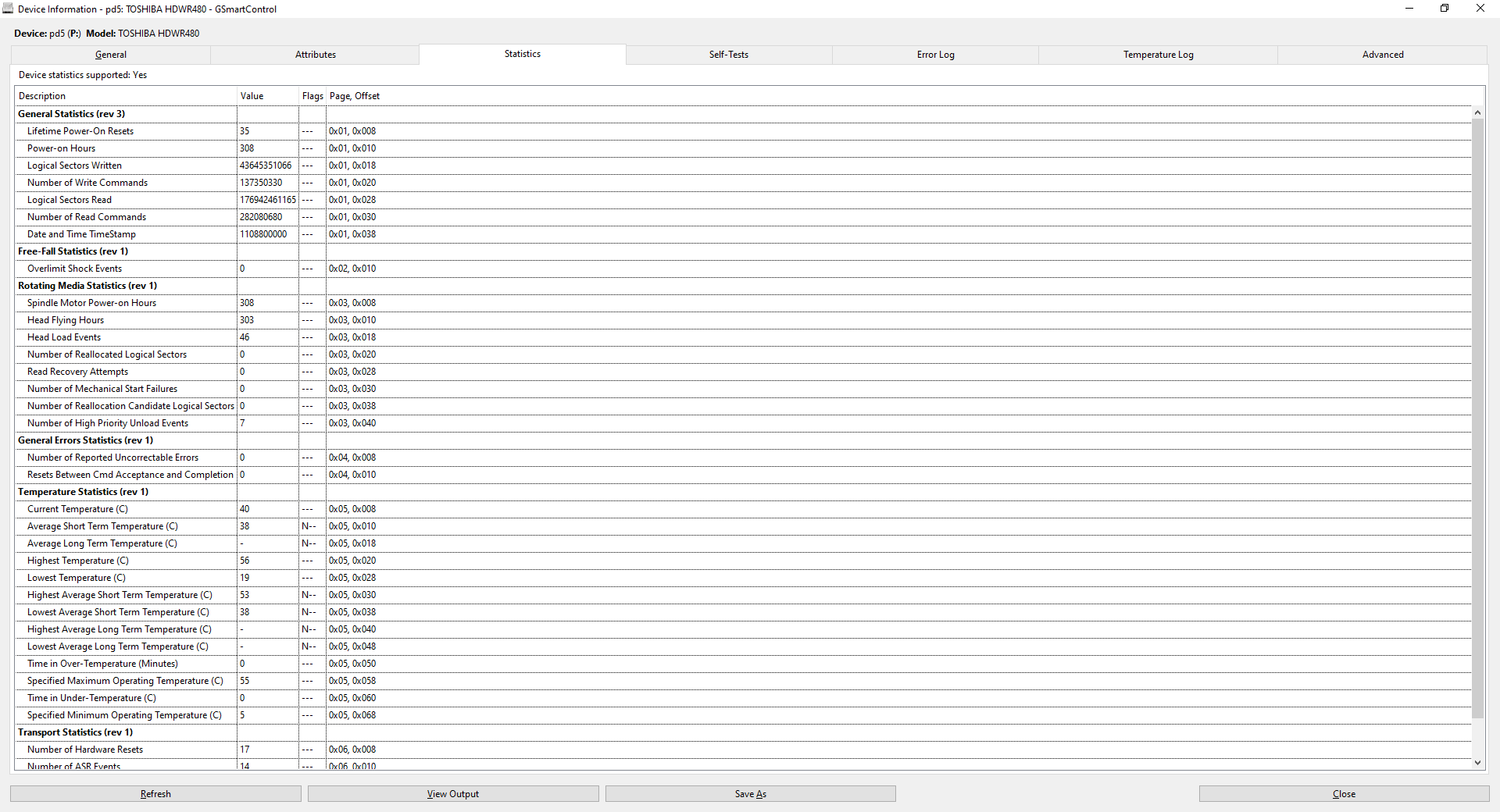 Device Statistics printout from a TOSHIBA HDWR480.

See also
- TOSHIBA HDWG480: Similar model binned for NAS applications.